Hitori rules
Shade some cells so the numbers left light do not repeat in any row or column. Dark cells cannot share an edge, and every light cell must stay connected through shared edges.
Remove repeated numbers
If two light copies of a number share a row or column, at least one copy must become dark. All numbers can be shaded; they are not fixed light clues.
A useful first deduction
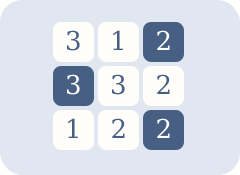
If two identical numbers are side by side, they cannot both be dark. Once you confirm one copy light, another copy in its row or column must be dark. A cell touching a dark cell must stay light.
Keep one light area
A corner touch does not connect light cells. Do not shade a cell if it would split confirmed light cells into areas that can never reconnect.
Mark and continue
Tap a cell to cycle dark → light → clear. Arrow keys move. D marks dark, L marks light, Backspace or Delete clears. The buttons apply to the selected cell. Undo removes the latest mark. Restart clears only this board after confirmation.
Hints and daily boards
Hint explains one forced choice; Apply this step marks that cell. If your marks cannot complete the board, undo an uncertain mark first. The daily mode uses a separate original set and fixes one board for the UTC date. Every practice and daily board has one solution.
Nikoli’s Hitori rules were used to check the rules. Shadefern’s number grids, interface and artwork are original.